Finding the right opportunity
not just the right interface
One Product, Two Opposing Needs
2024
Designing B2B2C employability mobile assessment across 4 key global markets.
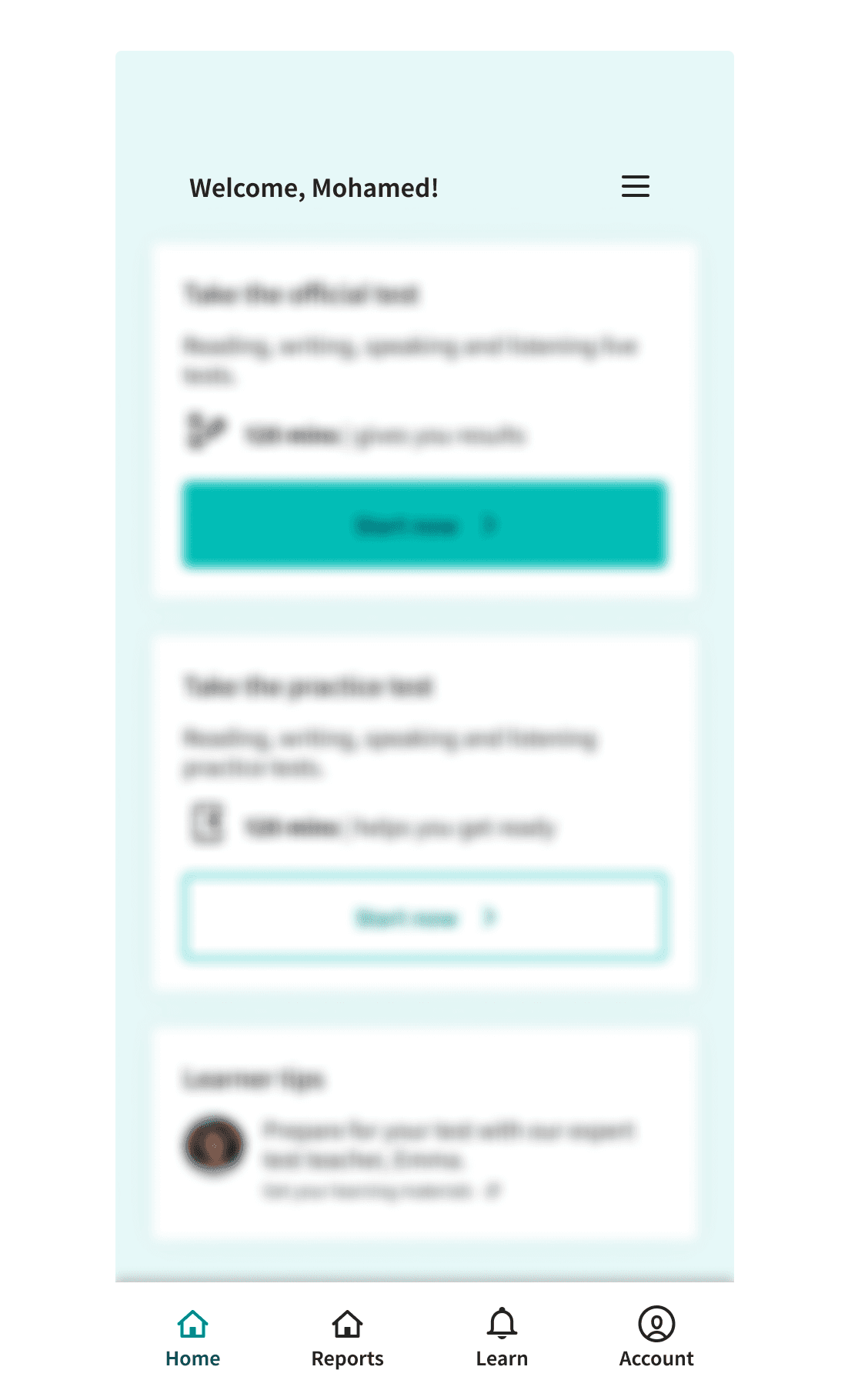
A mobile employability assessment experience for candidates seeking work and the centres validating results across four global markets. I balanced trust, accessibility, and compliance while evolving existing systems instead of starting from scratch.
Product Snapshot
Scale
4 international markets across Southeast Asia, Africa and the Middle East
Mobile-first assessment experience for candidates and assessment centres
Designed across diverse technical, cultural and regulatory contexts
Complexity
Balanced trust, accessibility, compliance and technical feasibility
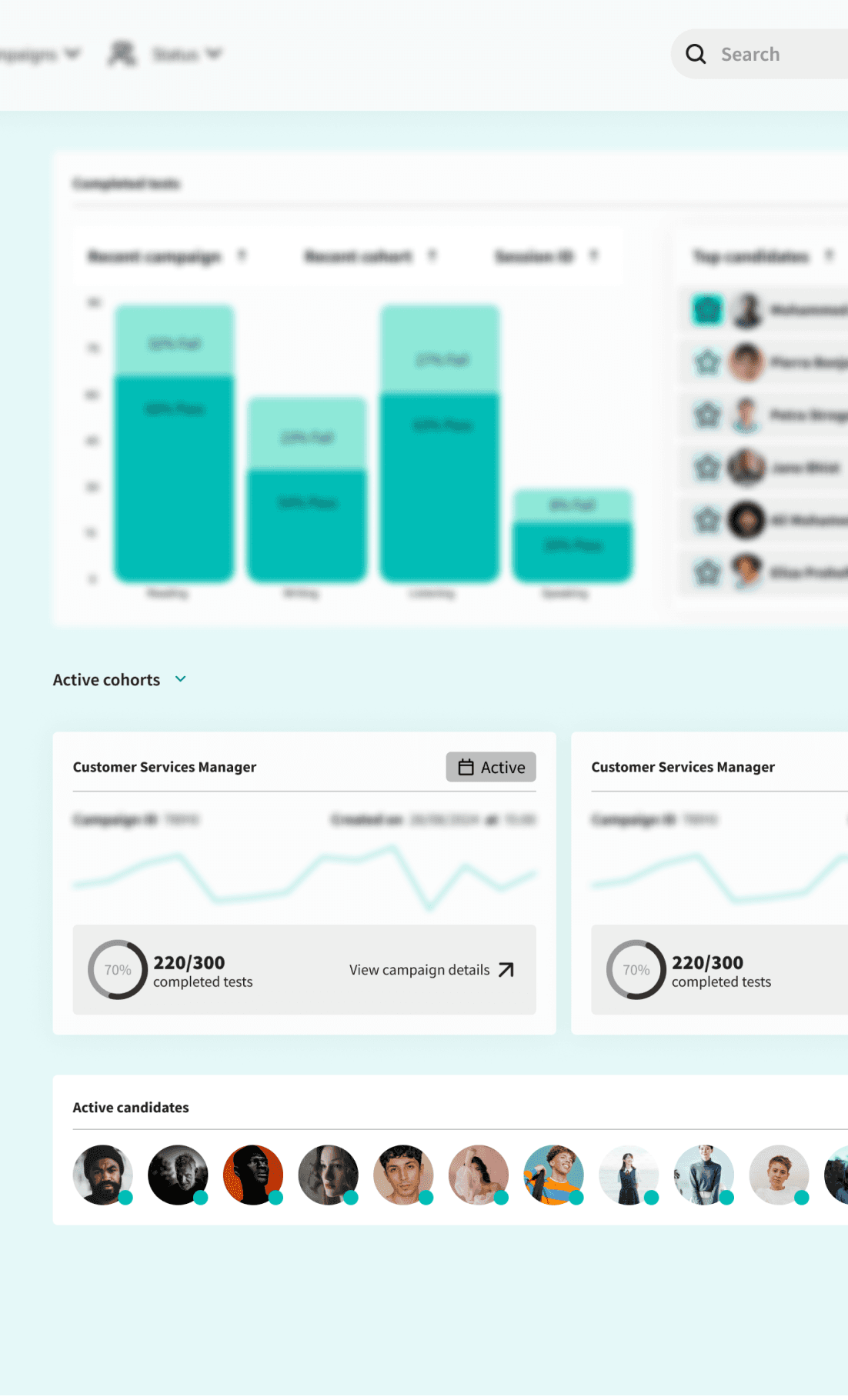
Designed connected experiences for two distinct user groups
Worked across product, engineering, pedagogy and commercial teams
Impact
89% positive prototype validation before development
Helped move the initiative from innovation into business-as-usual delivery
Reduced delivery risk through evidence-led validation
Context
As a contract Experience Designer, I led research and experience design for a mobile employability assessment designed to measure English proficiency for people entering new job markets.
Working across four markets in South East Asia, Africa, and the Middle East, I brought together research, pedagogy, engineering, and design to shape a product serving two very different audiences: candidates seeking employment opportunities and assessment centres responsible for administering and validating results.
The challenge wasn't simply designing an assessment experience. It was creating trust across markets with different infrastructure, regulations, and expectations, while building on systems that already existed rather than starting again from scratch.
Success depended on balancing user needs with assessment integrity, operational feasibility and commercial viability across multiple international markets.
The Problem
This product sat at the intersection of several tensions.
Candidates needed an experience that felt simple, calm, and fair during what was often a high-stakes moment in their lives.
Assessment centres needed confidence in identity verification, compliance, and candidate oversight.
Mobile was both the obvious platform and the hardest one to design for. It was the most accessible device across target markets, but also the least forgiving when balancing proctoring requirements, connectivity issues, and formal assessment standards.
Meanwhile, engineering constraints mattered. Existing infrastructure could dramatically reduce time-to-market, but only if we understood where it could support the experience and where it would limit it.
My Role
Understanding local contexts
I ran approximately twelve interviews across four markets, recruiting against tightly defined personas and using AI-assisted translation to preserve nuance across languages.
Combining these interviews with competitor analysis and internal expertise allowed us to replace assumptions with evidence early in the process.
Designing connected journeys
The product served two audiences with fundamentally different needs.
Candidates needed a low-friction assessment experience that stayed out of the way.
Assessment centres needed visibility, confidence, and control.
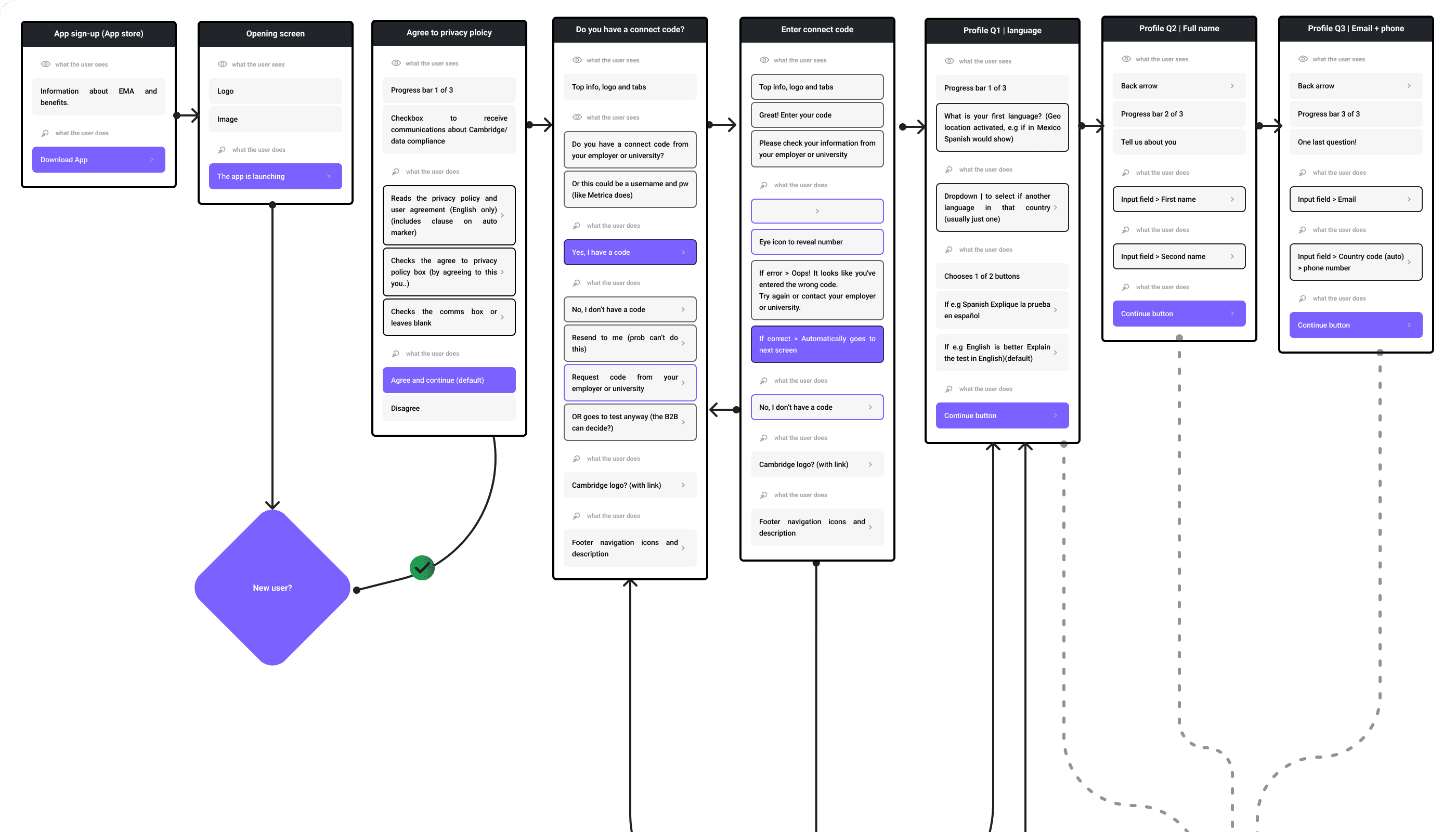
Rather than treating these as separate products, I designed them as two connected journeys within the same system.
De-risking delivery
I worked across departments from the outset to understand where existing systems could accelerate delivery and where they would constrain the experience.
That allowed us to move quickly, considering design solutions that could work alongside existing systems or as a stand alone product.
The Real Challenge
Creating products for global markets means recognising that one solution rarely fits all. Different cultures, infrastructures, regulations, and user expectations shape adoption. Success comes from designing systems that remain trusted and accessible while adapting to the realities of each market.
The hardest part of this project wasn't designing screens. It was holding multiple truths at once:
Candidates needed the assessment to be user friendly and quick.
Assessment centres needed confidence in the assessment process.
Engineering needed solutions that could ship potentially on existing infrastructure.
The business needed evidence before committing investment.
Optimising for any one of those in isolation would have weakened the product.
Key Decision
Design for flexibility, not uniformity.
Rather than creating a single experience for every market, I designed a framework that could adapt to different regulatory, technical and cultural contexts while maintaining trust, accessibility and assessment integrity.
Trade-off
Chose consistency of experience without enforcing identical solutions across every market.
Early Traction
Conducted ~12 interviews across four markets to ground decisions in evidence rather than assumptions.
Prototype testing generated an 89% positive response from participants.
Validated concepts with stakeholders embedded in target markets.
The work transitioned from innovation initiative to business-as-usual delivery, securing its next stage of investment.
What this reinforced
This project reinforced that product design is often less about interfaces and more about managing internal and external tensions. Balancing consumer simplicity with operational control, global reach with local nuance, and speed to market with technical reality.
The role wasn't to eliminate those tensions. It was to make deliberate trade-offs and ensure each side informed the others rather than competing with them.
Not every project ends with a launch. Sometimes success is reducing uncertainty enough that a business chooses to keep investing. I took this work from assumption to evidence to a validated prototype that moved into business-as-usual delivery.
Results
Balancing tensions with reality
Actively listening to internal and external perspectives
Moving from innovation to BAU
Delivering validated concepts